


Container Roof and Portable Solar Packs for Construction Site Power
Site power starts with a diesel generator in most construction projects. The set sits beside the container office, idles through the workday and keeps burning fuel even when the site is only running lights, laptops and a kettle.
On a job that lasts months, the costs pile up in ways that rarely show up on the original budget: fuel deliveries, refueling trips, oil changes, noise complaints and generator hire that simply will not end.
Solar changes that picture in two ways. One is to put the array on the container roof and let the office power itself. The other is to carry a foldable PV pack that moves with the site and deploys wherever the ground is open and the sun is out.
PowerLink builds both, and the choice between them comes down to how the site moves.
The Container Roof Pack
Container Roof PV Systems (CRSP series) mount directly on top of a site container. The target is the standard temporary site office, which in most markets means a 20ft or 40ft shipping container converted into offices, meeting rooms, canteens or sleeping quarters.
Four models cover the two container sizes:
7 kWp for 20ft offices, ten 700Wp bifacial dual-glass panels plus two 80Wp auxiliary panels, up to 42 kWh per day under 6 hours of standard sunlight.
14 kWp for 40ft offices, twenty 700Wp bifacial panels plus four 80Wp auxiliary panels, up to 84 kWh daily.
9.8 kWp for 20ft work offices, motorized foldable arms with remote or local retraction.
19.6 kWp for large 40ft camps, up to 118 kWh per day, enough for heavy office equipment and living loads.
The -E and -F variants differ in how the array expands. Electric versions unfold with one touch, locally or by remote control. Fixed foldable versions use manual arms. Either way, locating-pin brackets and transport frames let crews fix the unit to the container roof without specialized tools, and a folded unit leaves four packs shippable in one 40ft container, which matters on overseas projects.
See the full CRSP series specifications on the Solar Pack product page.
Where the Container Roof Pack Fits
- Construction camps: powers offices, tool charging, lighting and air conditioning instead of a diesel set.
- Remote site offices: covers sites with no grid access or long connection lead times.
- Long-running projects: a 20ft office on a CRSP7000 gets a full workday from 42 kWh of daily generation, depending on load.
- Zero ground footprint: the array rides the roof, so it takes no site space and creates no trip hazards.
The Portable Pack
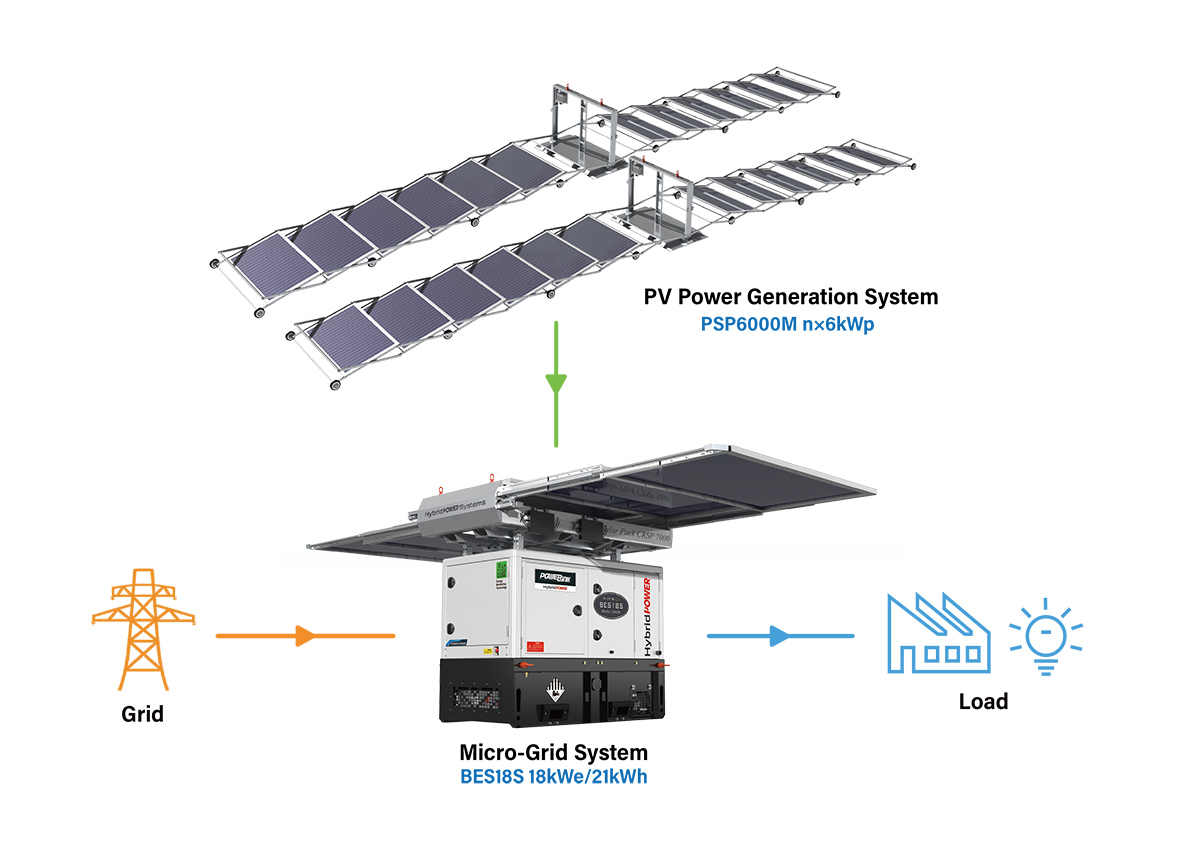
Portable PV Packs (PSP series) take the opposite approach. The array folds into a compact unit, travels with the project and expands on site into a wide flat PV array, like an accordion opening out. When the workfront moves, it folds back down and goes. No crane, no module disassembly, no waiting for a rewire.
The range spans manual and large-scale units:
6 kWp DC output at 451 V, manual expansion. Folds for storage and low-cost transport, unfolds for instant generation. Works with grid, diesel gensets and PowerLink hybrid microgrid systems.
7.8 kWp DC output at 624 V, fixed foldable structure. Collapses for hauling, deploys as a flat array for on-demand power scaling.
20 kWp AC output at 415 V, manual expansion, sized for larger temporary industrial loads.
96 kWp AC output at 415 V, integrated fold-unfold monolithic structure that moves without disassembling modules. Built to pair with large storage cabinets like the CHE250 or CHE500.
All PSP units accept grid, diesel and hybrid microgrid inputs, so the pack can be wired into a solar-diesel loop instead of replacing the genset outright. That hybrid setup is the configuration contractors ask about most, because it is where fuel savings actually show up.
Portable packs are part of the PowerLink Portable Energy application range.
Where the Portable Pack Fits
- Open-pit mining and exploration: large open ground and high sun exposure suit a flat deployed array.
- Temporary industrial sites: factories, yards and warehouses on short leases that need power fast.
- Phased construction: when the active workfront moves every few months, the pack relocates without crane or reassembly.
- Any open sunny area: clear ground and six-plus hours of sun are the only requirements.
What Is Driving the Interest in 2026
The search trends around temporary site power are easy to read this year. “How many solar panels in a 40ft container”, “solar panel for site office” and “solar diesel hybrid system” are climbing steadily, and each maps to a real decision contractors are making.
How Many Panels Fit on a 40ft Container Roof
The question behind the search is practical: how much PV can ride on top of a 40ft container. A 40ft roof offers roughly 27 square meters of usable area, and with current bifacial modules the practical answer is about 14 to 20 kWp. The CRSP14000 fits twenty 700Wp bifacial dual-glass panels and reaches 14 kWp with room to spare for the folding mechanism and auxiliary panels. At 84 kWh per day, that covers a container office through the workday and into the evening, including air conditioning in hot climates.
Solar Diesel Hybrid and the Fuel Math
A hybrid loop keeps the genset for backup and runs the site on solar during daylight. The daytime base load comes from the PV pack or roof array, the storage cabinet absorbs excess generation and covers short peaks, and the diesel set starts only for heavy surges or long overnight loads. Contractors who run this configuration report far fewer engine hours, which cuts fuel spend, oil changes and maintenance intervals. With diesel prices staying volatile through 2026, the payback keeps getting shorter.
PowerLink hybrid and microgrid systems are designed for exactly this solar-plus-storage-plus-genset configuration.
Solar for Site Cabins
Site cabins are where the container roof pack is the clearest fit. A 20ft office with a 7 kWp roof array replaces the small diesel set that would otherwise sit next to the cabin, removes refueling trips and cuts the noise crews live with all day. For rental fleets, a container with a built-in solar roof becomes a higher-value unit, because the renter saves fuel and the logistics of delivery and refueling.
Which Pack Fits Which Site
The rule of thumb: a fixed site with container offices takes the roof pack; a moving site with open ground takes the portable pack.
- Container offices and a stable layout for six months or more: CRSP7000 or CRSP14000 depending on 20ft or 40ft.
- Relocating site or shifting workfront: PSP6000M or PSP7800-F plus a CHE storage cabinet for night and surge loads.
- Large industrial or mining demand in the 50-100 kW range: PSP100K matched with CHE250 or CHE500 storage.
- Biggest possible fuel cut: run either system in a hybrid loop with the existing genset, sized so solar carries the daytime base load.
Storage and battery systems to pair with solar packs are covered in the PowerLink hybrid energy range.
Frequently Asked Questions
Send Us the Site Numbers
Every site has different loads, sun hours and diesel prices. A quick way to get a sized proposal: container size, site location, daily kWh consumption and the current generator rating.
PowerLink engineers will match the CRSP or PSP system, the storage cabinet and the hybrid controller to the actual site. Send your site details here.