



Why Off-Grid Construction Sites Are Switching to Hybrid Power
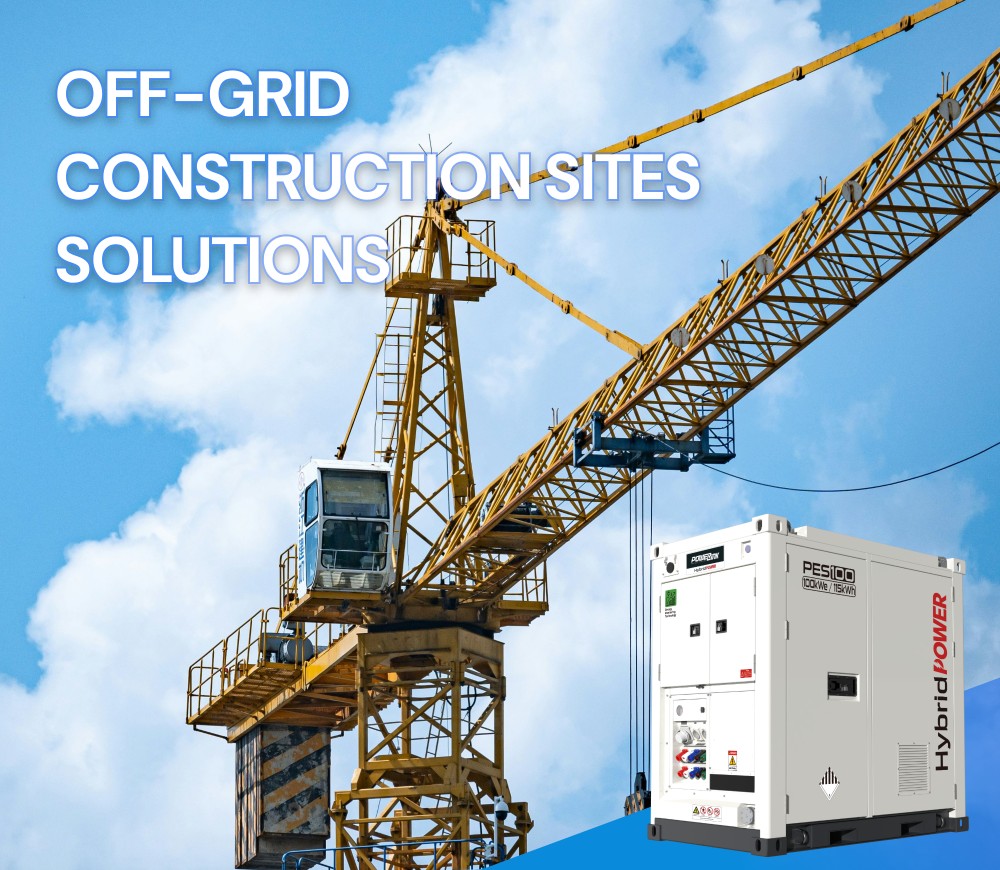
Off-grid construction sites have a power problem that has nothing to do with how many kilowatts of generating capacity happen to be installed on them. A site can run three oversized diesel generators and still stall a tower crane, burn fuel at a punishing rate, and fail a noise inspection in the same week.
The difficulty sits in the shape of the load rather than in the size of the supply, which is why simply adding another generator to the fleet rarely fixes anything. A hybrid energy system approaches the same problem from a different direction, by splitting the work each source handles best and then holding every source inside the band where it performs efficiently.
The Real Problem Is Load Shape Not Capacity
Construction Loads Arrive in Bursts
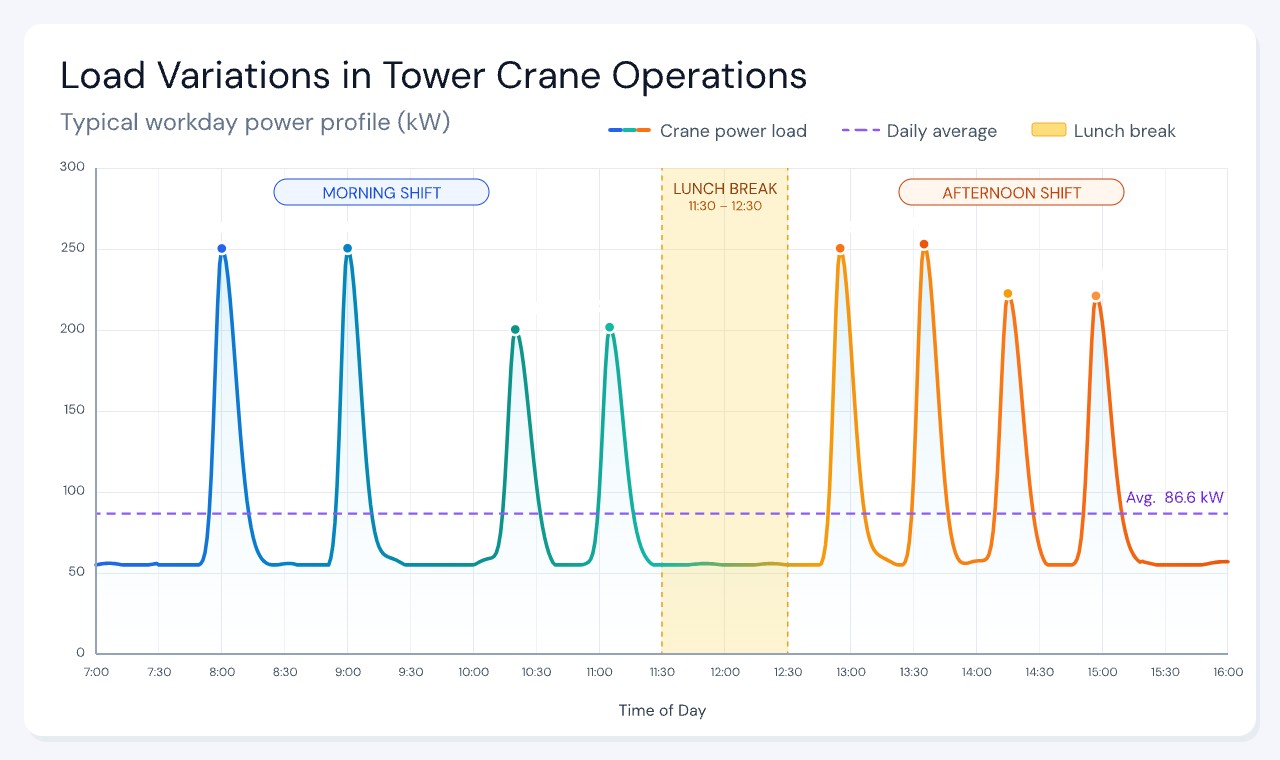
A tower crane lifting a loaded skip draws a brief and violent surge of current, then drops back to almost nothing once the load is set down. Welding machines, concrete pumps, piling rigs and stone saws behave in the same stop-and-go manner, so a site can swing from a handful of kilowatts to several hundred within a couple of seconds. Those two extremes, long quiet stretches interrupted by short spikes of demand, are what make life genuinely difficult for a generator that has to serve both.
Diesel Generators Are Poorly Suited to Those Bursts
A diesel engine reaches its best fuel efficiency somewhere between 60 and 80 percent of its rated output, and it is designed to sit there. Below roughly 30 percent it burns fuel out of all proportion to the work it performs, runs too cool to burn cleanly, and leaves unburned fuel in the exhaust system and the lubricating oil. A generator chosen to carry a crane’s peak demand therefore spends most of its working life in precisely the band it handles worst.
The damage from that mismatch tends to show up as accumulated maintenance rather than as one dramatic breakdown. Injectors foul, exhaust systems load up with soot, service intervals shorten, and the set eventually starts shutting down under load at the worst possible moments. On a project inside a low emission zone the same machine also has to satisfy noise and exhaust rules that a generator running at full output cannot realistically meet.
What Power Redistribution Actually Means
Splitting Base Load From Peak Load
Redistribution begins with measurement, since the profile of a site’s demand is what determines which source should serve which part of it. The demand is then divided into two categories, and that division follows how the current behaves rather than what the equipment happens to be. Continuous base load covers the equipment that runs for the whole shift, which on most sites means offices, temporary lighting, dewatering pumps, security systems and small power tools. Peak load covers anything drawing heavily for seconds at a time, which on most projects means cranes, welding plant and the larger pumps.
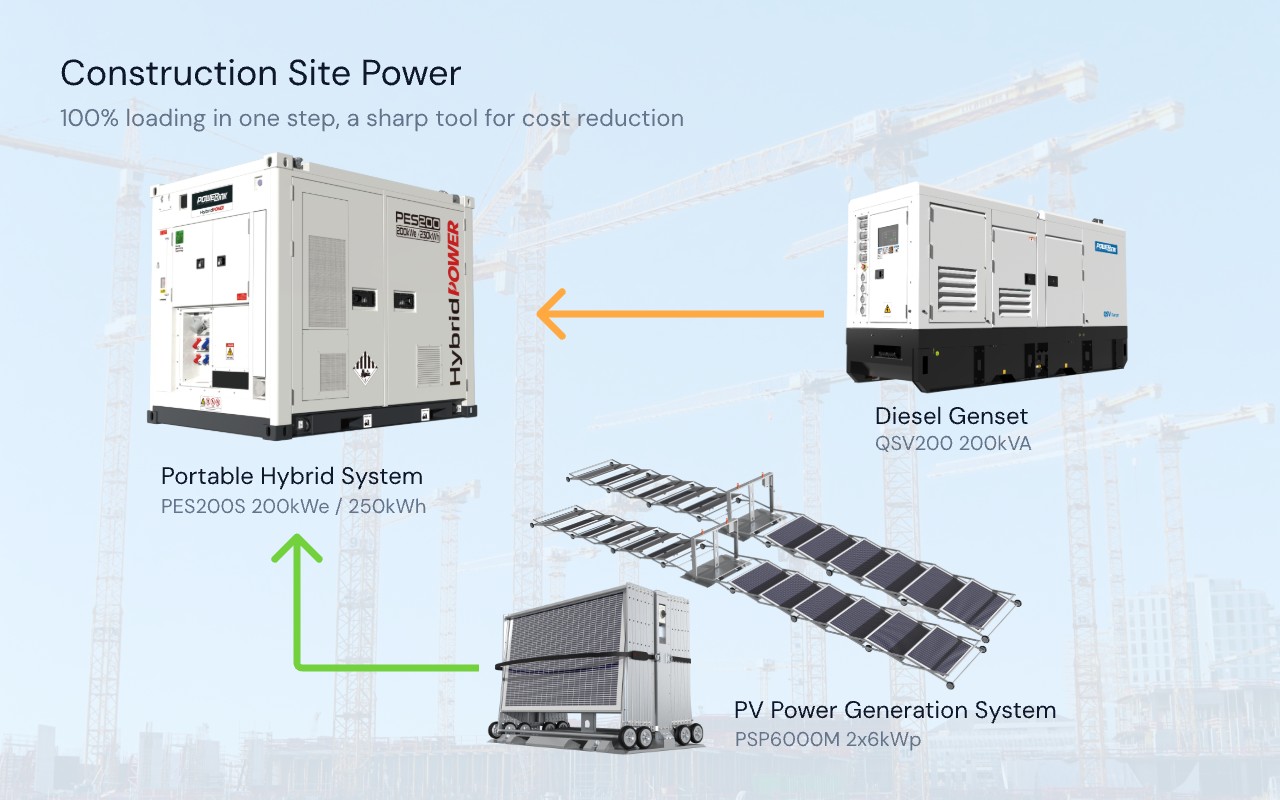
The two categories are then sent to different sources, because each source suits one of them and handles the other badly. Base load suits a generator running steadily inside its efficient band, where fuel consumption per unit of work is at its lowest. Peak load suits a battery bank that can discharge hard for a few seconds and then recharge in the gaps between lifts.
Turning the Generator Into a Charger
Once storage carries the peaks, the generator’s role shifts from chasing load to holding a fixed output and recharging the battery between events. That single change is what allows a modest auxiliary set to serve a site whose instantaneous demand is several times its own rating. It is also why a hybrid site can end up with less installed generator capacity than a diesel-only site, and why a straight count of machines tells you very little about which configuration is actually better.
| Aspect | Diesel-only site | Hybrid site with storage |
|---|---|---|
| Generator sizing | Matched to peak demand, so oversized for the base load it actually serves | Sized for base load plus battery charging |
| Typical load factor | Often 20 to 35 percent | Held between 60 and 80 percent |
| Peak handling | The generator must absorb the spike directly and recover afterwards | Storage discharges instantly, the generator is undisturbed |
| Fuel use | High, and disproportionate at low load | Lower; on a Dubai tower crane project fuel cost fell by 94 percent |
| Maintenance | Wet stacking, injector fouling, shorter service intervals | Fewer running hours under load, longer intervals |
| Noise | Engine runs at varying speed for as long as the site is live | Engine runs at a steady point and can be off for long periods |
| Regenerative energy | Dissipated as heat in braking resistors | Captured and returned to the battery |
| Low emission zone compliance | Hard to meet with oversized diesel plant | Achievable |
The PES range is built around exactly this split between base load and peak, and the eight units in the range span 100 to 500 of output with 125 to 624 kWh of battery capacity. Each model accepts photovoltaic input between 50 to 110 kWp and can recharge from either the mains or a diesel set, which lets the same hardware serve a site with no grid connection at all. The full specification table, including the parallel cabinets and photovoltaic string cabinets that support larger installations, sits on the PES series range page.
What Changes on Site When Load Is Redistributed
Fuel Consumption and Maintenance Intervals
Fuel savings come from two separate mechanisms rather than from one, and both of them depend on the engine spending its running hours in the right band. The generator stops burning fuel at low load, where consumption per unit of work is at its worst, and it stops running altogether during quiet periods once the battery has been recharged. Because the remaining running hours are spent in the efficient band, maintenance intervals extend as well, and the wet stacking that shortens engine life largely stops happening.
Noise and Emissions Compliance
An engine held at a steady and efficient load is quieter and cleaner than the same engine ramping up and down all day long. The units in the range sit at 58 dBA, which keeps night work and city-center sites inside limits that oversized diesel plant struggles to satisfy. Several European and Gulf projects now treat hybrid plant as the practical route to working inside a low emission zone without reducing the work the site is able to do.
Recovering Energy on the Way Down
Tower cranes and hoists return energy whenever a load descends or the drive applies its brakes, and on a diesel-only site that energy turns into heat in the braking resistors and is lost. With storage connected to the same circuit it flows back into the battery instead of dissipating, and on crane-heavy projects the recovered energy covers a measurable share of the following shift’s demand. That recovered energy is what makes the fuel figures on tower crane projects so much better than a simple load-factor calculation would predict.
Matching a PES Unit to an Off-Grid Site
Reading the Site’s Load Profile
Sizing starts from a load profile rather than from a single peak figure, because the ratio between peak and average demand is what determines how much storage the site actually needs. A week of logged data is usually enough to separate base load from peak, and where logging is impractical the schedule can be read from the crane and pump ratings together with the shift pattern. Two numbers matter more than the rest, namely the highest instantaneous demand the site will present and the average continuous demand across a full working day.
Sizing From the PES Range
The storage capacity is then chosen to cover the peaks and to bridge the gaps between generator runs, while the generator is chosen for the base load plus whatever charging current the battery will accept. A useful check is to confirm that the battery can absorb the full charging output of the generator, since a set that outruns its battery simply ends up idling again. Because the range steps in predictable increments and shares one container footprint, a site can start with a single unit and add capacity later without redesigning the installation, which matters on projects whose power demand grows as the build progresses.
| Model | Output power | Battery capacity | PV input | AC charger | Noise at 7 m | Units per 40 ft |
|---|---|---|---|---|---|---|
| PES100S | 100 kWe | 124.8 kWh | 60 kWp | 1 x 30 kW | 58 dBA | 5 |
| PES100SP | 100 kWe | 124.8 kWh | 60 kWp | 1 x 30 kW | 58 dBA | 5 |
| PES200S | 200 kWe | 249.6 kWh | 60 kWp | 2 x 30 kW | 58 dBA | 2 |
| PES200SP | 200 kWe | 249.6 kWh | 60 kWp | 2 x 30 kW | 58 dBA | 2 |
| PES200L | 200 kWe | 233.0 kWh | 50 kWp | 1 x 40 kW | 58 dBA | 4 |
| PES300S | 300 kWe | 374.4 kWh | 110 kWp | 3 x 30 kW | 58 dBA | 3 |
| PES400S | 560 kWe | 499.2 kWh | 100 kWp | 4 x 30 kW | 58 dBA | 2 |
| PES400L | 560 kWe | 465.9 kWh | 100 kWp | 4 x 20 kW | 58 dBA | 2 |
| PES500S | 500 kWe | 624.0 kWh | 110 kWp | 5 x 30 kW | 58 dBA | 1 |
Every model outputs 380, 400 or 415 V three-phase and carries IP54 protection, so the same unit suits a range of site distribution voltages without modification. Individual product pages cover the PES30S plug-and-play unit, the PES60S low-noise hybrid power unit, the PES200S hybrid generator battery system, the PES300 off-grid hybrid power system and the PES500 portable hybrid energy system. Where a site needs storage, photovoltaic input and diesel backup designed together as one package rather than assembled from separate suppliers, the PV, battery and genset hybrid configuration covers that combination.
A City-Center Tower Crane Project in Practice
The Starting Configuration
A high-rise project in downtown Dubai ran four tower cranes, each drawing a peak instantaneous 67.5 kW for a site total of 270 kW. The original supply was a group of 800 kVA diesel generators, a configuration that produced enormous fuel consumption and heavy maintenance bills across the whole build. It also conflicted directly with the low emission zone rules covering the district, which restricted both the noise and the exhaust the site was permitted to produce.
What the Hybrid System Changed
The replacement paired storage with a small 250 kVA set used mainly for charging, which made storage the primary source and the generator the auxiliary one. Instantaneous peaks are now covered by the battery, and the regenerative power produced during descent and no-load phases is captured rather than burned off in resistors. Fuel cost fell by 94 percent against the original diesel setup, generator running time dropped from continuous operation to six hours a day, and the site met the emission rules that had been a persistent problem throughout the early stages of the build.
The full write-up, including the network configuration and the measured results, is on the tower crane energy storage case study. A second project applies the same principle to temporary camps, where small sites run 5 to 10 kW of photovoltaic with 10 to 20 kWh of storage and larger camps move up to the PES300 or above alongside a standby generator, described in the field construction camp case study. Construction power beyond hybrid storage, including diesel sets from 6 kVA to 4000 kVA and lighting towers, is collected on the construction power page.
Decide by Load Shape
The useful question on an off-grid site is not how many kilowatts the plant is rated for but how the demand behaves across a full shift. Once that profile has been measured, the answer usually points to redistribution rather than to additional capacity, because peaks and base load want very different things from a power source. Storage absorbs the spikes, the generator runs steadily in the band where it is efficient and clean, and regenerative energy returns to the battery instead of to the atmosphere.
Talk to PowerLink About Your Load Profile
PowerLink runs three manufacturing plants covering more than 900,000 square feet and supplies energy systems into 98 countries, so a sizing catalog conversation here starts from configurations that have already been built rather than from a catalog sheet. Bring whatever you have measured, whether that is a full week of logged demand or nothing more than the crane and pump ratings alongside the shift pattern, and the engineering team can turn it into a storage capacity, a generator rating and a fuel comparison against running the site on diesel alone. The aim is not to sell a larger machine but to establish which source should carry which part of the load, and that answer looks different for a tower crane project and a temporary camp, which is why the case studies above are worth reading alongside the numbers.
All products provided by our company are energy products. Welcome to contact us and speak to an energy solutions expert at info@powerlinkenergy.com.