


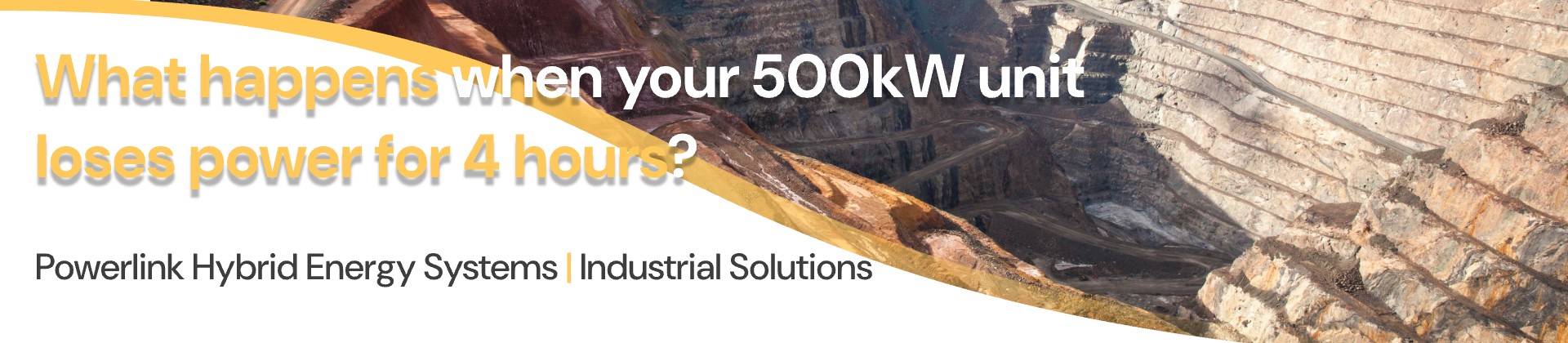
When a mining camp loses grid connection at 2 AM, the diesel generators start. They burn fuel at a rate that converts budget line items into operational emergencies. They run for 11 hours before the line crew arrives. Multiply that across outage hours per year, per site, and the cost becomes a number that keeps procurement managers awake.
Operators who run diesel-only backup know the pain points. The equipment is loud. The maintenance intervals are punishing. The emission standards in Australia, the EU, and North America are tightening faster than fleet replacement cycles. A diesel generator at this scale burns fuel continuously, accumulates service hours rapidly, and faces regulatory pressure from every direction. None of this includes the cost of a generator failure during a production window.
Powerlink engineers hybrid energy systems for this exact operating environment. The product line spans output ratings from 3.6kWe to 1,350kWe, with battery storage capacities from 6kWh to 2,912kWh. The large-frame configurations, reaching 1,000kW output with 2,000kWh storage, are containerized hybrid energy systems designed for continuous duty in remote, high-temperature, high-dust conditions.
The Diesel Arithmetic No Longer Works
Three converging forces are reshaping the economics of industrial backup power:
Fuel Cost
A diesel generator at a remote site burns fuel proportionally to its load. Remote site delivery adds transport surcharges, and wet season road closures introduce weeks of buffer inventory. The fuel bill compounds with every unplanned hour of runtime.
Maintenance Burden
Diesel engines require oil changes every 250 to 500 hours, air filter replacements, and periodic overhauls. A unit running frequently accumulates service events that demand scheduled downtime, parts inventory, and technician availability—all at a premium.
Regulatory Pressure
EU Stage V and equivalent standards now apply to non-road mobile machinery. Sites in emission-controlled zones face operating hour restrictions or fines. The regulatory trajectory points to fewer permissible diesel-only runtime hours per year.
A hybrid system that cuts diesel runtime by over 60% transforms the operating economics. Instead of the generator running continuously, it runs only to charge the battery or during sustained high-load windows. The financial case recovers the incremental battery investment within a timeframe measured in months to a few years. It is an operational cost reduction with a measured return.
How the Powerlink Architecture Solves the Diesel Problem
Powerlink’s large-scale hybrid systems pair a lithium iron phosphate (LiFePO4) battery bank with a diesel generator through a proprietary energy management system (EMS). The battery absorbs variable loads and peak demand transients. The generator runs only to charge the battery or during sustained high-load windows.
This topology changes the generator’s operating profile entirely. Instead of idling at low load where diesel efficiency collapses, the generator operates at its optimal load point (typically 70% to 80% of rated capacity) for far fewer total hours. The battery handles the load transients that would otherwise force the generator into partial-load operation where fuel consumption per kWh is at its worst.
LiFePO4 chemistry was chosen deliberately. Cycle life exceeds 6,000 charge/discharge events at 80% depth of discharge—equating to roughly 10 years of daily cycling. Thermal stability is significantly better than NMC alternatives, which matters when the system sits inside a sealed container at a Pilbara mine site where ambient temperatures reach 45°C.
Where Systems at 1,000kW Scale Make the Difference
The top end of Powerlink’s hybrid portfolio addresses operations where a power interruption is not an inconvenience—it is a safety incident or a financial loss measured in dollars per second.
Data Centers
A facility with a 500kW IT load has seconds of UPS runtime. The hybrid system for data centers bridges the gap between utility failure and generator synchronization without voltage sag. The battery also participates in peak shaving, discharging during high-tariff periods.
AI Computing Clusters
GPU training workloads present a challenging profile: sustained draw above 95% for weeks, followed by idle periods. A hybrid system for AI computing eliminates the need to overbuild utility connections for peak demand, increasing revenue per square foot for colocation operators.
Remote Mine Camps
A 200-person camp requires 300kW to 500kW. Diesel delivery introduces logistics cost and supply chain exposure. A hybrid system for mine camps with solar PV integration cuts diesel consumption by over 60% and extends generator service intervals.
Grid Support & Industry
Factories in regions with unstable grids experience voltage sag that damages electronics. Powerlink’s PES and PHE series provide frequency and voltage stabilization. The system can island the facility during grid disturbances and reconnect seamlessly once utility power returns.
The EMS Is Where the Engineering Value Lives
The hardware consists of battery cells, inverters, and a container. The true differentiation is the control system.
Powerlink’s proprietary EMS performs real-time load forecasting and source dispatch. It decides, at sub-second intervals, whether to draw from battery, start the generator, pull from solar PV if connected, or shed non-critical loads. The decision logic accounts for battery state of charge, generator warm-up time, predicted load trajectory, time-of-use electricity pricing, and solar irradiance forecast when PV is integrated. For a complete overview, see the commercial battery storage solutions page.
Measured across the deployed fleet, the system achieves over 60% fuel savings compared to diesel-only operation. A mechanical governor on a diesel engine cannot match generation to load at the granularity a battery inverter and EMS can achieve together.
Remote monitoring operates through EnerWeb, Powerlink’s IoT platform. Operators access real-time telemetry, historical trend data, and predictive maintenance alerts through a web portal or mobile app. The platform generates ESG reports tracking fuel displacement, CO2 reduction, and energy source mix directly into corporate sustainability reporting frameworks.
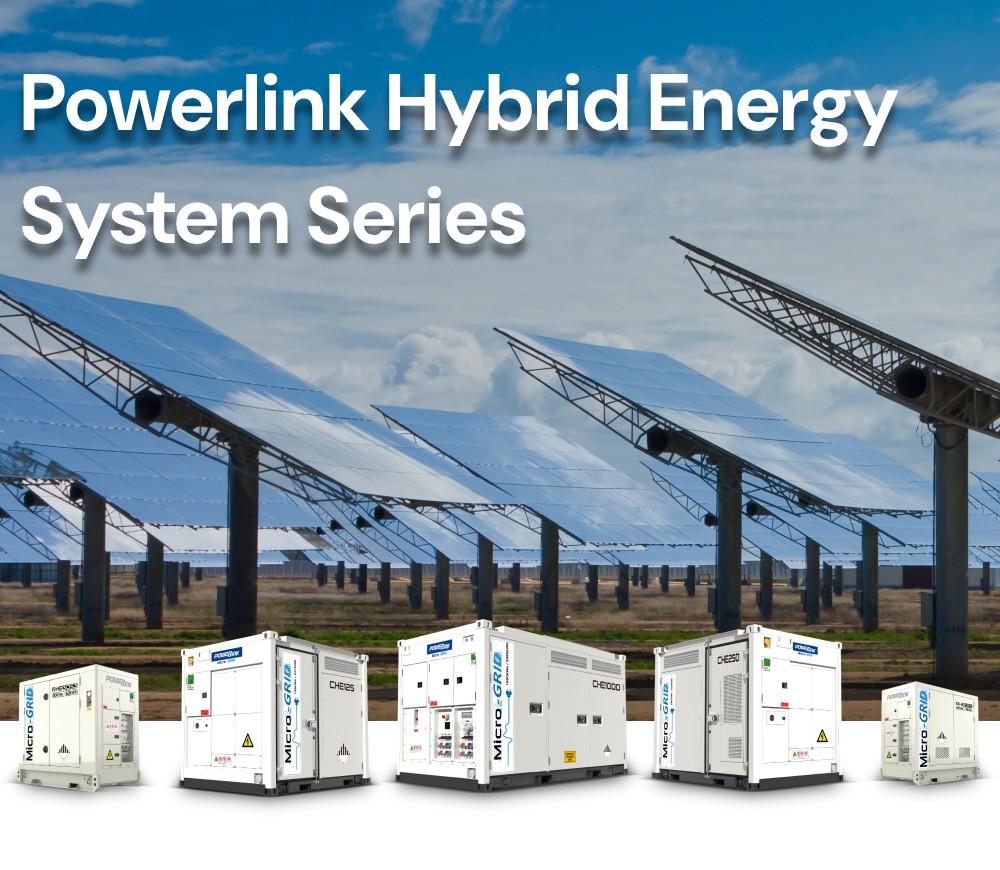
Physical Design and Deployment
- The systems ship in standard ISO containers with integrated fire suppression.
- Each battery pack has an independent fire protection pipeline using perfluorohexane agent.
- Electrical terminations use quick sockets and copper busbars.
- Commissioning requires a level pad and a cable connection—no civil works, no specialized foundation.
Post-commissioning maintenance is minimal. The inverter and battery modules are maintenance-free. The only recurring task is monthly dust cleaning of the power distribution board and a monthly charge/discharge cycle to maintain battery calibration. Generator maintenance intervals extend because engine hours decrease proportionally with fuel consumption.
Frequently Asked Questions
Q What battery chemistry does Powerlink use and what is the expected service life?
LiFePO4. Cycle life exceeds 6,000 events at 80% depth of discharge, equivalent to approximately 10 years of daily cycling. The chemistry does not propagate thermal runaway, which is a critical safety property for unattended containerized installations.
Q Can the system integrate with existing solar arrays?
Yes. Solar PV connects through MC4 connectors accepting a DC input range of 250V to 900V. The EMS treats solar as the priority generation source and charges the battery from PV before starting the generator.
Q What is the conversion loss from DC battery to AC output?
Approximately 2%. DC to AC inversion efficiency is roughly 98% across the operating range.
Q How does the system handle motor starting and inrush currents?
The battery inverter delivers surge current for motor starts and inrush loads. The EMS monitors the load trend and starts the generator proactively if sustained load approaches the inverter’s continuous current rating.
Q What warranty does Powerlink provide?
Two-year comprehensive warranty on the complete system. Battery modules carry up to a 10-year warranty. Support includes installation guidance, system commissioning, operator training, and full product lifecycle management.