


Shore Power Cable vs. Mobile Battery Storage: Which Makes Sense for Your Port Pattern?
Shore power availability remains limited across global ports. A vessel calling at six ports on a coastal route may find cold ironing at only one of them. At the other five, the crew runs the auxiliary diesel engine for the duration of the port stay, burning fuel around the clock to keep lights, communications and refrigeration running.
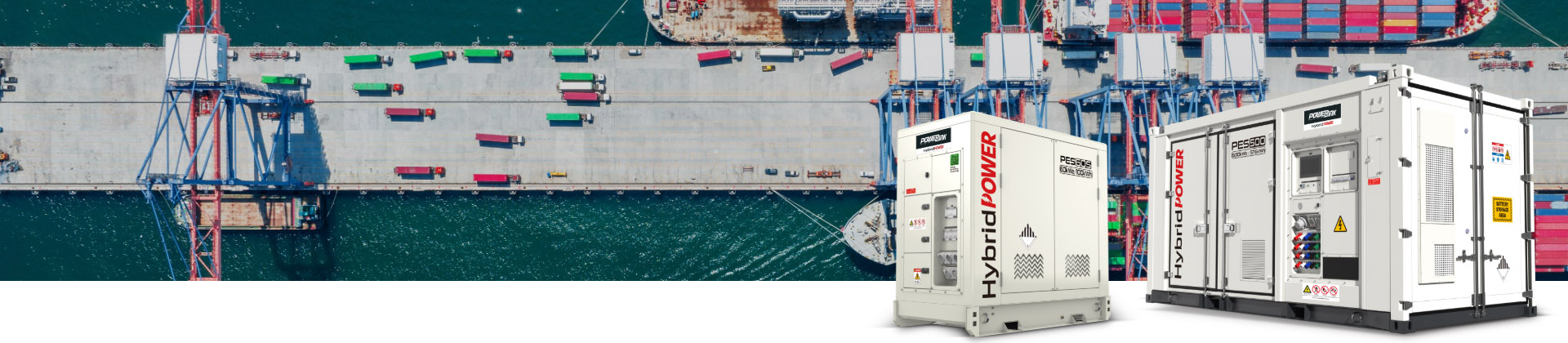
Two paths are available. The first is to wait for port authorities to install fixed shore power cable at each berth, a multi-year infrastructure project over which the vessel operator has no direct control. The second is to bring your own power: a containerized mobile battery storage unit that travels with the vessel or sits at the berth. Powerlink’s PES series, a battery system delivering 30 to 500 kW output with 62 to 576 kWh capacity, is built for the second path.
This article does not declare one path better than the other. It maps out which approach fits which operational reality.
Path One: Shore Power Cable
How It Works
Shore power, also called cold ironing or high voltage shore connection (HVSC), is a permanent installation at the berth. It consists of a substation connection to the local grid, voltage transformers matching the ship’s voltage and frequency, and a cable management system delivering power from shore to ship.
When a vessel connects, the auxiliary engines shut down. Emissions at the berth drop to zero. Crew and dockworkers benefit from the silence. No exhaust, no vibration, no fuel consumption.
Where It Exists Today
The Port of Los Angeles has offered shore power at its container terminals since 2014, following California’s at-berth emission regulation. Rotterdam has equipped multiple terminals for cold ironing, driven by EU environmental mandates and operator demand. The Port of Long Beach credits its shore power program with cutting diesel particulate matter by over 90% at connected berths. In Northern Europe, ports in Norway and Sweden lead in adoption, supported by government subsidies for both port-side and ship-side investment. But these are the exceptions. For every electrified berth, there are dozens that are not.
The Limitation
Shore power works at the berth that has it. If your vessel calls at Laem Chabang in Thailand, which has shore power, you plug in. If the next port is Tanjung Priok in Indonesia, which does not, you burn diesel. The vessel operator has no direct control over when or whether a port electrifies its terminals. The investment decision sits with the port authority. The timeline sits with the port authority. If the port delays, you wait and you keep buying diesel.
Path Two: Mobile Battery Storage
How It Works
Mobile battery storage is a self-contained containerized unit that delivers power without depending on port infrastructure. It comes to the ship, not the other way around.
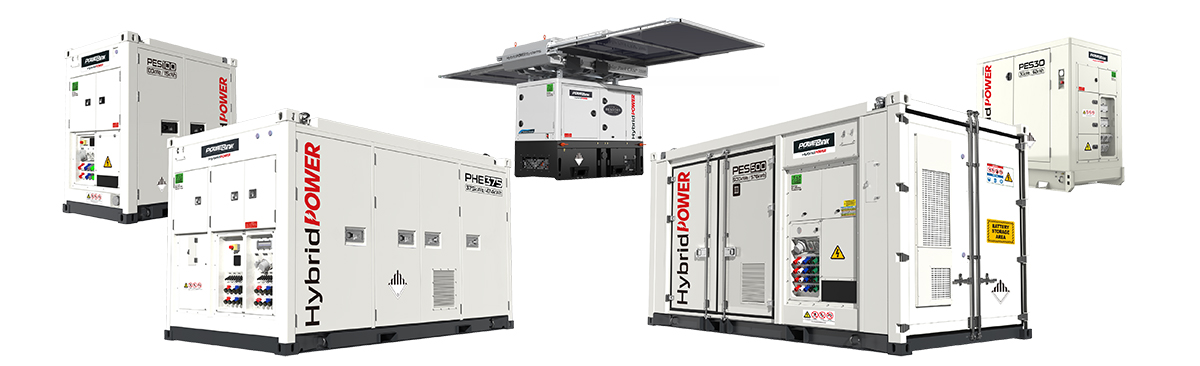
Powerlink’s PES series combines lithium battery storage with grid, generator, and PV charging inputs in a single enclosure. Grid power charges the battery when a basic electrical outlet is available at the port. A diesel generator connection provides backup and supplementary power when battery charge is low or loads exceed battery capacity.
PES Series Specifications
| Model | Continuous Output | Overload | Battery Capacity | Voltage | Cooling |
|---|---|---|---|---|---|
| PES100S | 100 kVA/kW | 140%, 10S | 125 kWh | 380/400/415V | Air |
| PES100S PLUS | 100 kVA/kW | 274%, 10S | 125 kWh | 380/400/415V | Air |
| PES200S | 200 kVA/kW | 140%, 10S | 250 kWh | 380/400/415V | Air |
| PES200S PLUS | 200 kVA/kW | 300%, 10S | 250 kWh | 380/400/415V | Air |
| PES200L | 280 kVA/kW | 140%, 10S | 233 kWh | 380/400/415V | Liquid |
| PES300S | 300 kVA/kW | 140%, 10S | 374 kWh | 380/400/415V | Air |
| PES400S | 400 kVA/kW | 140%, 10S | 499.2 kWh | 380/400/415V | Air |
| PES400L | 400 kVA/kW | 210%, 10S | 466 kWh | 380/400/415V | Liquid |
| PES500S | 500 kVA/kW | 140%, 10S | 624 kWh | 380/400/415V | Air |
Overload capability ranges from 140% to 300% for 10 seconds depending on the model (see table above), providing headroom for motor starting and transient loads. Cooling options include air cooling for S models, liquid cooling for L models for different operating environments.
Deployment Flexibility
Because the PES unit is self-contained, deployment is flexible. It rides on deck as a container and travels with the vessel. It is stationed at a regular port of call and serves multiple vessels sequentially between arrivals. It is trucked between nearby ports when route schedules shift. At any berth, the crew connects the vessel to the PES unit and switches off the auxiliary engine. No port infrastructure is required at any of these locations.
Application Scenarios
The PES series is designed for port, ship power supply, construction, mining, racing events, emergency backup, equipment leasing and other off-grid applications. Each scenario shares the same requirement: reliable power in a location where the grid connection is absent or insufficient.
Head-to-Head Comparison
Six practical dimensions clarify the tradeoffs between the two approaches.
| Dimension | Shore Power Cable | Mobile Battery Storage (PES) |
|---|---|---|
| Infrastructure | Major port-side project. Grid study, substation, transformer, cable management, civil works. Multi-year timeline. Port authority led. | None required at the port. Self-contained unit delivered ready to operate. Deployment in weeks. Operator controlled. |
| Port Coverage | One berth only. Vessel must call at that specific location to benefit. Adjacent terminals may have no coverage. | Any berth. Any port. One unit serves multiple berths or multiple ports. Moves with the vessel or is repositioned between calls. |
| Vessel Modification | May require onboard shore connection panel, sync switchgear and cable handling equipment. Retrofitting an existing vessel is a yard project. | Connects to existing electrical bus. Outputs standard AC at 380/400/415 V. Dockside installation in most cases. No major yard work. |
| Energy Source | Grid electricity only. Carbon footprint depends on the local grid generation mix at that port. | Multiple inputs. Grid for off-peak top-up. Diesel generator for backup. Operator controls the energy mix. |
| Flexibility | Fixed to the berth. If the vessel changes route next year, the shore power investment does not transfer. | Movable. Stays with the vessel across route changes or serves multiple vessels at one port. Investment is in the equipment, not the location. |
| Scalability | Step-function investment. Adding a second berth repeats the full project cycle at similar cost. | Incremental. Start with one unit for the most fuel-intensive port call. Add units as the hybrid fleet grows. Right-size by model (50 to 500 kW). |
Three Port Patterns, Three Decisions
Pattern A: Fixed Route, Both Ends Electrified
A ferry operator runs the Dover to Calais crossing multiple times daily. Both terminals have shore power. The vessel connects during every turnaround. For this operator, the economics of mobile battery storage center on a different use case. A PES unit charged overnight from off-peak grid power and grid power can buffer the ferry’s peak shore power draw during quick turnarounds, reducing demand charges from the port utility. The battery does not replace shore power here. It reduces the cost of using it.
Pattern B: Multi-Port Route, Mixed Electrification
A refrigerated cargo vessel runs a coastal route in Southeast Asia. It calls at six ports. One, a modern container terminal, has shore power. Five do not. The port stay at each call ranges from 12 to 36 hours, during which the vessel’s reefer containers and hotel systems run continuously on the auxiliary engine.
For this operator, waiting for all six ports to install shore power cable is not realistic. A PES unit sized to the vessel’s load profile covers the five non-electrified port calls. At the one electrified port, the PES charges from the grid while the vessel draws shore power. Across the full route, auxiliary engine runtime at berth drops to near zero. The operator achieves this without depending on port infrastructure timelines.
Pattern C: No Fixed Route
A tramp shipping operator sends its vessels where the cargo dictates. Next month’s ports might be in West Africa. The month after that, the Mediterranean. There is no fixed route to justify electrification investment at any single port.
For this operator, the only viable path is the mobile model. A PES unit stowed on deck or in a container slot travels with the vessel everywhere. At any berth, regardless of infrastructure, the vessel runs on battery power. The unit charges during transit from the vessel generator or from the vessel’s main generator at an efficient load point. When the route changes, the PES moves with it.
How Both Paths Work Together
The Combined Approach
The two approaches are not mutually exclusive. A vessel that calls at a mix of electrified and non-electrified ports uses both. At an electrified berth like Rotterdam’s container terminals, the vessel connects to shore power. In parallel, the PES unit charges from the grid during the port stay. At the next port call where shore power is not available, the vessel draws from the PES unit. Shore power handles the connected berths. Mobile storage handles the rest.
Bridging the Infrastructure Timeline
The combined approach also serves port authorities mid-stream on long-term electrification programs. A PES unit deployed at a berth today provides immediate emission reduction while the permanent shore power cable project moves through design, permitting and construction. When the cable is commissioned three to five years later, the PES unit is redeployed to the next non-electrified berth on the port’s priority list. The port achieves emission reduction in year one, not year five, while infrastructure is built in parallel.
Next Steps
Choosing between shore power cable and mobile battery storage begins with understanding your own operational reality: how many berths, how many calls per month, how many hours per stay, and what electrical load the vessel draws while docked.
Powerlink’s engineering team works from your vessel specifications and port schedule data to model both scenarios side by side. The output is a direct comparison of capital investment, operating cost, emission reduction and deployment timeline. No industry averages. No generic recommendations. Numbers tied to your actual operations.
Ready for a Custom Fleet Assessment?
Contact Powerlink to request a detailed port pattern assessment specifically tailored for your fleet’s operations.