


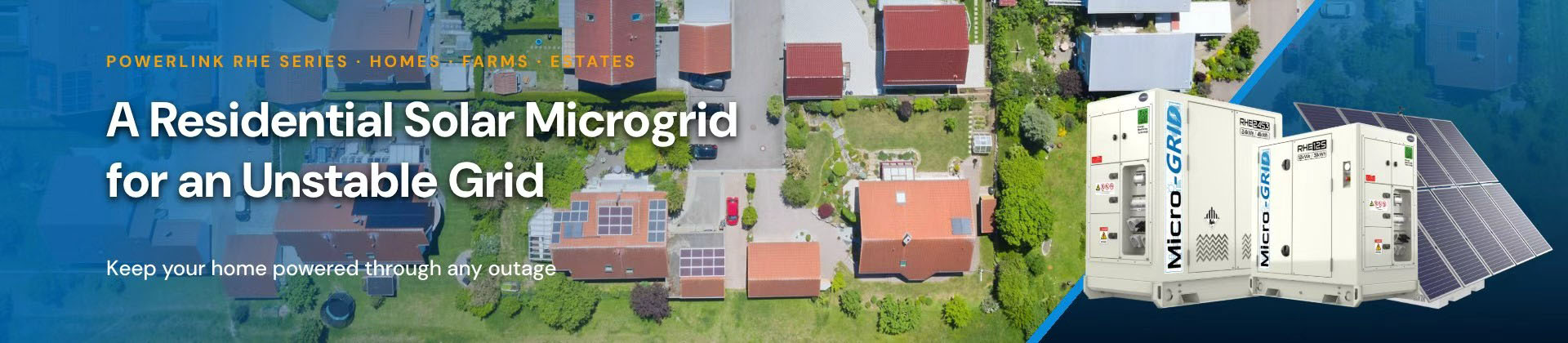
How a Residential Solar Microgrid Carries a House Through an Unstable Grid
A residential microgrid is a small, self-contained power system that combines a solar array, a battery bank, and a bidirectional inverter to keep a house energized when the utility supply drops or drifts. It islands from the grid automatically, runs the loads from battery and photovoltaic input, and reconnects once the supply returns within the voltage and frequency window. In places with reliable sunlight and an unreliable grid, that combination is the whole design premise.
Two conditions make a home a candidate for this architecture rather than for a standby generator. The grid has to fail often enough or badly enough that power outages carry a real cost, and the site has to receive enough solar irradiance that the array can carry the daily load for most of the year. Where both are true, the economics and the reliability case point the same way.

Why an Unstable Grid Changes the Load Calculation
Engineers who size a residential microgrid from an average monthly bill usually get it wrong, because the bill describes consumption rather than capability. An unstable grid does not simply remove power at random; it browns out, cycles, and returns at inconsistent voltage, and each of those behaviors stresses a different part of the system. The calculation therefore has to start from the behavior of the supply, not from the number of kilowatt hours consumed last year.
A grid that drops for two hours twice a week demands a battery sized for a short, frequent cycle. A grid that fails for two days after a storm demands a battery sized for autonomy, which is a far more expensive problem. A grid that stays up but sags to 170 V during peak hours demands an inverter that can hold the load while correcting the voltage, and a transfer scheme fast enough that sensitive equipment does not reboot. These three cases share a bill profile and need three different systems.
The practical consequence is that the first deliverable in any residential microgrid project is not a product list but a supply record. Logging voltage and outage frequency for four to eight weeks costs almost nothing and prevents the most common failure of these projects, which is a system sized for the wrong kind of outage. A single week of logging usually exposes the problem, and four weeks is enough to size against it.
What a Residential Microgrid Consists Of
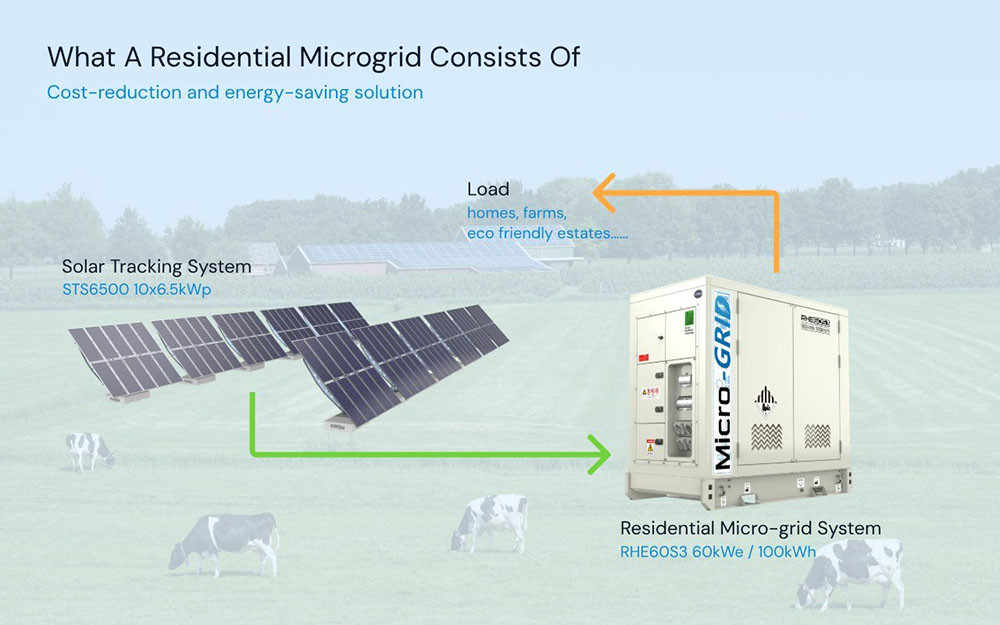
The architecture is short enough to describe in three parts, and understanding the boundary of each part is what makes specification straightforward. A residential microgrid contains a generation source, a storage buffer, and a conversion and control stage, and each of the three answers a different question about the site. Once those three boundaries are clear, model selection becomes arithmetic rather than a judgment call.
The Inverter and the Transfer Path
The inverter converts direct current from the battery and the array into usable alternating current, and it decides when the house sits on the utility and when it islands. Continuous output rating, phase configuration, and output voltage are the three figures that decide the rating, because they determine which household loads can run simultaneously and whether the site needs a single-phase or a three-phase connection. Transfer time is the fourth, and it is the one most often underspecified.
The Battery and What It Covers
Battery capacity is quoted in kilowatt hours and describes energy, not power. A battery that stores a working day of consumption will carry a site through an evening outage and will not carry it through a two-day one, and the difference is a capacity decision rather than a technology decision. Depth of discharge and round trip efficiency reduce the usable figure below the nameplate, so the planning number is always lower than the data sheet number.
The Photovoltaic Array and the MPPT Window
The array is quoted in kilowatt peak and describes instantaneous generation under standard test conditions. What counts on site is the input window the inverter can accept, because an array that exceeds it is clipped and an array that sits well below it leaves harvestable energy uncollected. In high-irradiance regions, the array is normally sized above the inverter output on purpose, and the clipping is accepted in exchange for a longer productive window morning and evening.
How Much Battery a House Actually Needs
The battery figure is the one that decides budget, and there are two defensible ways to arrive at it. The first is a load profile built from measured consumption in fifteen-minute intervals, which gives an honest picture of the evening peak and the overnight baseline. The second is a coverage table agreed with the homeowner, which says explicitly how many hours of which loads the system must support, and it is often the better document because it forces the conversation about what is actually essential.
In practice, the essential list is shorter than homeowners expect and narrower than installers assume. Refrigeration, lighting, communications, water pumping, and medical equipment usually survive; electric water heating, space heating, and EV charging rarely do at full rating. Writing that list down before selecting a model prevents the situation where a system technically meets its specification and still disappoints the household.
Where Each RHE Model Fits
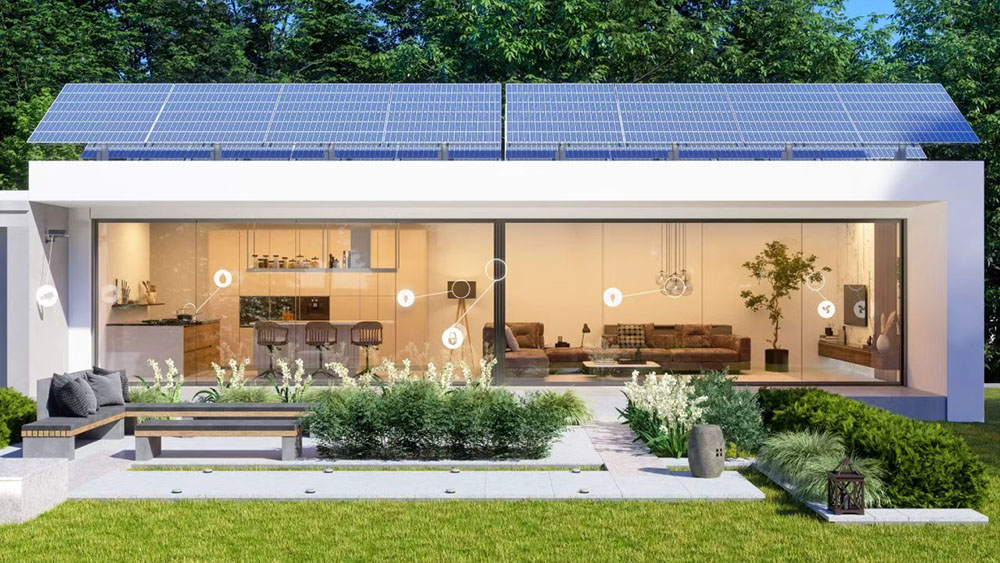
The PowerLink RHE Series is engineered for homes, farms, and eco-friendly estates, and it integrates with the public grid rather than replacing it. The series spans five models, and the progression is not simply larger output but a different configuration assumption at each step. The table below lists the published ratings exactly as they appear on each product page.
| Model | Continuous Output | Phase | Output Voltage | Battery Capacity | PV Input |
|---|---|---|---|---|---|
| RHE12s | 12 kVA / 12 kW | 1 or 3 | 220 / 230 / 240 V (1P); 380 / 400 / 415 V (3P) | 30.72 kWh | 18 kWp |
| RHE12s3 | 24 kVA / 24 kW | 1 or 3 | 220 / 230 / 240 V (1P); 380 / 400 / 415 V (3P) | 40.96 kWh | 18 + 18 kWp |
| RHE30 | 30 kVA / 30 kW | 3 | 380 / 400 / 415 V | 75 kWh | 62.21 kWh or 74.88 kWh |
| RHE60 | 60 kVA / 60 kW | 3 | 380 / 400 / 415 V | 100 kWh | 99.84 kWh |
| RHE100 | 100 kVA / 100 kW | 3 | 380 / 400 / 415 V | 125 kWh | 124.80 kWh |
The naming carries the configuration intent as well as the rating. RHE12 is the compact unit, RHE24 is expandable, RHE30 is wired three-phase four-wire, RHE60 runs hybrid mode, and RHE100 adds cloud energy management. Reading those labels before comparing prices prevents the mistake of treating five models as one product line in five sizes.
A dual-input figure such as 18 + 18 kWp on the RHE24 describes two photovoltaic inputs rather than one, which changes the yield on a roof with two differently oriented planes. A single input forces the strings onto one maximum power point, and an east-west roof therefore loses yield that a two-input unit recovers without any additional hardware. On a single-plane roof, the second input buys nothing, which is why the configuration should follow the roof and not the reverse.
A documented household deployment of this series, with the measured effect on electricity cost, is set out in the RHE Series residential case study.
What Changes When Sunlight Is Abundant
High irradiance is usually treated as a benefit and it is, but it changes the design balance in ways that catch out systems sized on European assumptions. The array produces more than the house consumes for more hours of the day, and the surplus has to go somewhere useful rather than being curtailed by default. Three consequences follow from that, and each one moves a different figure in the specification.
Oversizing the Array Without Oversizing the Battery
In a high-yield location, it is rational to install an array well above the inverter continuous rating, because the extra capacity produces usable energy in the shoulder hours when a smaller array would still be below the load. The battery does not need to grow in the same proportion, because its job is to move energy across hours rather than to store the whole day. Decoupling the two sizing decisions is the single largest cost lever available in these markets.
What the Surplus Does
Surplus generation has four destinations and each has a different value. It can charge the battery, export to the grid where a feed-in tariff or net metering arrangement exists, drive deferrable loads such as water pumping or pool filtration, or be curtailed. Deciding the priority order during design rather than after commissioning is what separates a system that earns its cost from one that simply runs.
Where a site needs generation, storage, and a diesel set on the same bus, the trade-offs are set out in our article on hybrid energy systems.
Where the Microgrid Stops and the Grid Starts
A grid-interactive microgrid is not an off-grid system, and the distinction decides both compliance and expectation management. It imports when the utility is healthy, exports when surplus exists and local rules permit, and islands only when the supply falls outside the acceptable window. Every one of those transitions needs to be defined in the commissioning document.
The three conditions that most often cause trouble after handover are anti-islanding behavior during a planned utility outage, export limits imposed by the local network operator, and the reconnect delay after the grid returns. All three are visible in the inverter settings and none of them are visible in the brochure, so they belong in the specification conversation. A commissioning sheet that records each setting against the local rule closes the gap between what was sold and what was installed.
What to Settle Before Asking for a Quote
A supplier can only size accurately against a defined brief, and the following items are what turn an inquiry into a specification. Collecting them before the first meeting shortens the process considerably. Each item below takes minutes to gather and each removes a round of questions from the quotation stage.
Questions Buyers Ask Before Committing
The four questions below come up in almost every residential microgrid inquiry, and the answers depend on the configuration rather than on the product family. They are worth settling in writing before the purchase order. Each answer changes once the phase configuration or the essential load list changes, so they are worth revisiting at handover.
That depends on the essential load list rather than on the battery figure alone. A 30.72 kWh battery on the RHE12 will carry a refrigeration, lighting, and communications load for well over a day, and will carry an electric water heater for a few hours at most. The honest answer is always expressed as a load and a duration together.
Export depends on the local network operator rather than on the microgrid itself. Where export is permitted and metered, surplus generation is sold; where it is capped or refused, the design should prioritize self-consumption and deferrable loads instead. This needs confirming with the utility before the array is sized.
The system synchronizes and reconnects once voltage and frequency sit inside the acceptance window for the configured period. The reconnect delay is a settable parameter, and it exists to protect the utility network rather than the house. Sensitive equipment should be on a circuit that tolerates that delay or on the backup output.
It reduces the energy the battery must store overnight, and it does not remove the need for autonomy when the outage extends past sunset into a cloudy day. In high-irradiance regions, the array can often be oversized relative to the inverter while the battery stays modest, which is where the cost saving sits. Treating abundant sunlight as a substitute for autonomy is the most common sizing error in these markets.
Ready to Design Your Residential Microgrid Solution?
PowerLink supplies the RHE Series with single-phase and three-phase configurations from 12 kVA to 100 kVA. Send us your supply record, load profile, and essential load list, and our engineering team will size the exact system for your site.